Make Room: A Review
What happens to us when we've spent so much of our lives carrying things that we no longer remember who we were before we picked them up?
For a while, I have been thinking about how we haven’t heard many stories about COVID. I mean, not the stories of death and lockdowns and the brutality of that season on most people. Not the stories about how we couldn’t move, or how we were forced to sit indoors and learn how to make banana bread while asking utawezana. Or how husbands spent whole days washing cars in the parking lots because they didn’t know the people in their houses. Not the stories about what happened to the world. But stories closer to home, stories that happened to us. Stories that affected our souls in very specific ways. Stories about what happened to relationships, the decisions we made when everything was uncertain, and the things we discovered about ourselves when life as we knew it came to a halt. Stories that pushed our emotions to their limits and changed how we loved, trusted, and saw ourselves. Stories about decisions that subtly or dramatically flipped the scripts of our lives.
There is a story here titled Ward Seventeen about someone waking up from a coma, a coma he sank into just before the world was locked down. A friend is by his bedside when he wakes up and has the difficult task of updating him on how the world has been. Oh, and this friend by the bedside is the reason the friend is in a coma.
…you're worried because you know he'll ask about his grandfather; the man who raised and understood him better than anyone. His grave is still fresh, and you can't be the first one to break that news to him, surely? The story of his grandfather's death can't be told without mentioning that Chinese city. It was over a year since that shitshow, but you still hadn’t gotten your head around what in Wuhan's name, 2020 was.
Even at your storytelling best, the thing you take pride in, you don't have the emotional tone to tell that story. You think about how someone more creative, someone with more depth and humour - because a story like this needs both - needs to write a script about someone who has to tell a friend who has just woken from a coma about everything that happened in 2020.
That piece was just a rant about how someone should write that story. I have already given the premise and the background. The characters already have some meat, and the scene is already set. I imagine it will have a lot of push and pull between the characters, with the potential to pull apart our hearts as we learn their decisions, their guilt, their forgiveness or lack thereof, their ability to say what they mean and their capacity to hold the tensions that will arise from the conversation. In Ward Seventeen, it's just these two people talking, crying, almost fighting, sitting in silence, heaving.
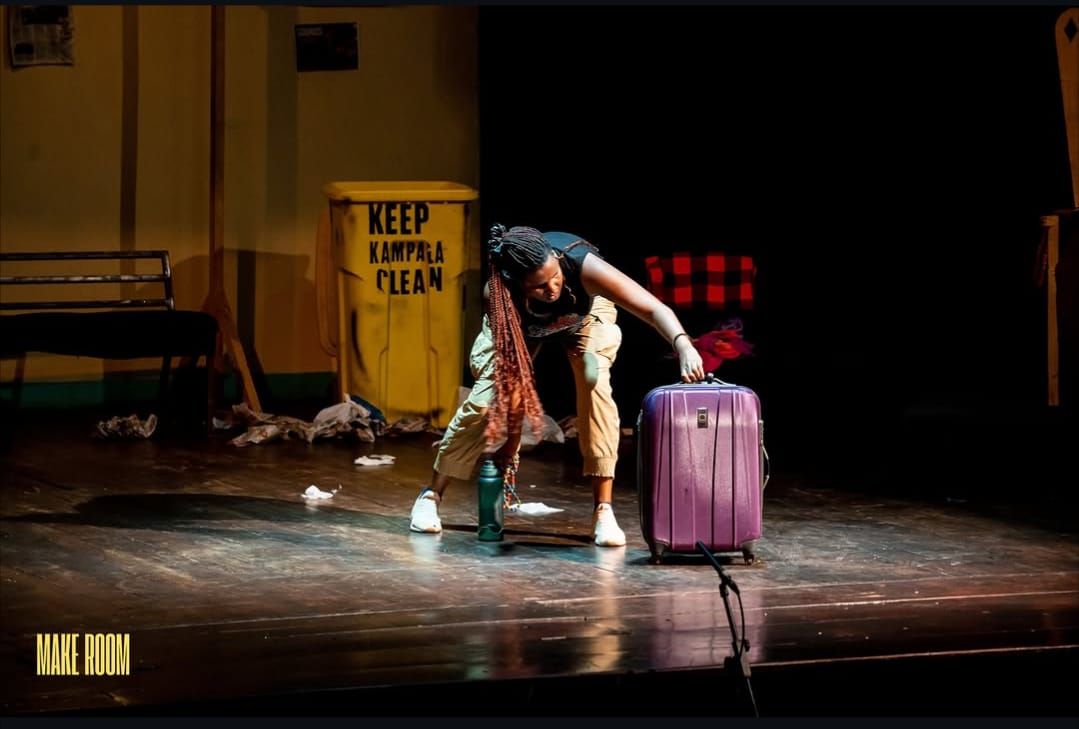
At KITFEST last week, I watched a story like that, not about someone in a coma, but about a young woman whose life is coming apart. With curfew looming, Kabibi, our character, finds herself stranded on the streets of Kampala. It's called Make Room, such a beautifully layered title, a one-woman show written and performed by Brenda Ibarah.
It starts at a bus stop. Kabibi has several bags with her, carrying what appears to be everything she owns. The set at Ukumbi Mdogo is stripped down, with a few posters hanging behind her. As the show went on, the posters kept peeling off and falling to the floor. It wasn't intentional, but it worked. There was something fitting about the set slowly falling apart as her life unravelled. One of the posters was a ‘No Smoking’ warning sign. Meanwhile, she sat there with a cigarette in hand. It was giving a man letting it stream next to a usikojoe hapa writing on a wall.
As the evening unfolds, Kabibi takes us through her story. We learn her friend has kicked her out of their shared apartment. Through her narration, phone calls, texts, and flashbacks, we begin to piece together the details of her life. There's her relationship with her mother, a deeply religious woman whose devotion borders on the cultish, and her relationship with her absent father, who happens to have another family. In a flashback, she has a conversation with him, and the setup is such that his chair is kinda hidden behind a pillar. Visually, that was brilliant. For a man who has been largely absent from her life, it felt rather fitting. There is her relationship with her friends who, in her predicament, empathise with her from afar.
She has spent a good part of her life carrying things that don't always have names, but take up space. The anxiety of wondering whether people like you. The sting of feeling unwanted. The rejection you keep revisiting long after the person who rejected you has moved on. The little voice in your head that is always finding something wrong with you. The need to keep everyone happy, even when it means making yourself smaller. Some of the things weighing her down are things she has carried for so long that she may not even recognise them as weight anymore.
All she does is hold. Hold her head high, hold her liquor, hold on to hope, hold her tongue, hold on to memories, hold her breath, hold on to people, hold back her feelings, hold herself responsible, hold it together. Hold herself together for everyone else. No one seems to have ever held her. The realisation that she was tired of it all hits her hard when she realises she has to let go of her luggage, as well as her, you guessed it, emotional baggage, in order to make room. Her life was an accumulation of things she loved and had to learn to let go. People, relationships, versions of herself, possibilities that never became.
It is a brilliant show, and Brenda doesn't have to do too much to convince us of that. She doesn't push the story to extremes to make a point, or shove its message down our throats. She lets us find our way into it. Through her narration, she draws us into Kabibi's world, opening up different boxes of her life. She is wonderful to watch. She holds the room with such ease and moves effortlessly on stage. And all the character work she did - playing the role of the mother, the father and the pastor was so seamless. I laughed, felt sorry for her, and was frustrated by her. Some moments made me happy, like when she refused to fall when the pastor was praying for her. It is quite something to sit through a performance and find yourself feeling so much for someone whose life you have only just stepped into.
The story works because it manages to be both personal and communal. Kabibi's circumstances are specific to her: a job loss, friends who don’t show up when she needs them most, the complicated family dynamics. But none of these experiences are entirely hers. Most of us will recognise ourselves in them, which, really, is the point of art, especially great art. It holds a mirror to our faces and helps us see our stories from a different point of view.
For an hour and some minutes, Kabibi invites us into the most intimate parts of her life. She asks us to sing along, shares her text exchanges, and lets us sit through a nervous phone call with her mother, who, like many mothers, will always tell you to go home. She makes us privy to the things we don't always get to see or hear about another person's life. She asks us what happens to us when we've spent so much of our lives carrying things that we no longer remember who we were before we picked them up. She forces us to ask what it will take to heal. To let go.
When our lives are busy, as they often are, we rarely have time to reflect. Then the world stops, as it did in 2020, when Brenda started writing the show, and we are forced to face ourselves and feel the feelings we are experts at burying. When life slows down enough, we get these kinds of stories. Make Room leaves us with questions that make us uncomfortable when we look in the mirror because we don’t recognise who we see there.